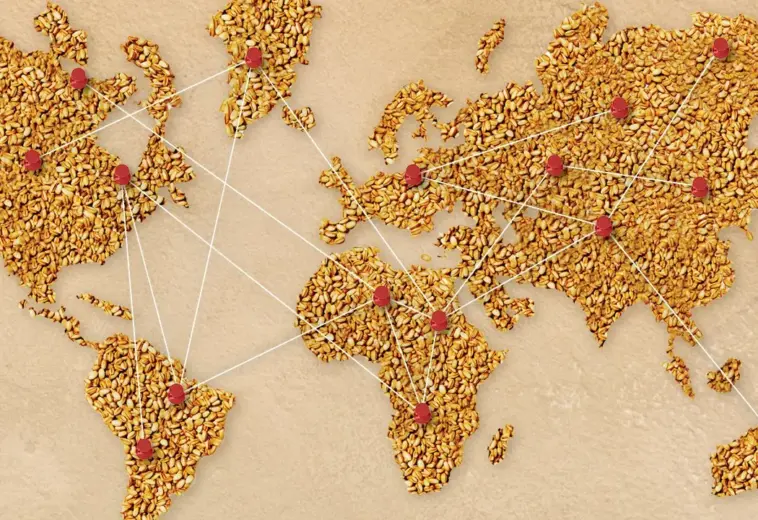

The closure of the Strait of Hormuz — through which a third of nitrogen fertilizers transit — has triggered a shortage of nitrogenous fertilizers, sending prices skyrocketing. The price of urea has surged by an average of 45% in just a few weeks. To cope with scarcity and rising costs, farmers worldwide are being forced to find alternative solutions, including inputs derived from waste and microbial products. Faced with this logistical and energy vulnerability, agriculture has turned to the circular economy. Demand for biofertilizers and biostimulants has indeed exploded, but it is not enough. One of the most original alternatives is the use of human urine, which startups collect in schools and at festivals to transform into microbial fertilizer.
The crisis is expected to persist, and its effects on fertilizer prices, crop yields, and declining agricultural production are likely to be felt until 2027. According to the FAO, fertilizer prices across all categories have risen by 33%, pushing an additional 45 million people into nutritional distress. In April, the price of urea reached $710 per tonne, its highest level since 2022. The price of Egyptian urea surged by 90%, reaching $940 per tonne.
Out of necessity, farmers are being forced to turn to fertilizers they had previously considered less reliable than chemical inputs. In Malaysia, some dairy producers use livestock waste to feed worms that enrich the grass grazed by their cows. Biofertilizers, previously regarded as expensive and of inconsistent quality, are experiencing a surge in demand. The European Union is encouraging the use of organic fertilizers and digestate, a by-product of biogas production. These makeshift solutions have a strong chance of becoming permanent fixtures.
The cost of these alternative solutions is generally lower than that of conventional fertilizers. They could reduce reliance on chemical fertilizers by 50%, and their price is, on average, 20% lower. A tonne of chicken manure trades at just $13!
Bio-based Fertilizers from Waste Recycling
Four categories can be identified.
Anaerobic digestion digestate (alternative to nitrogen)
Digestate is the nutrient-rich organic residue produced from biogas generation (anaerobic digestion of waste).
- Sources: livestock slurry and manure, food scraps, and crop residues.
- Relevance in 2026: As noted above, the European Union is promoting their use as a direct replacement for urea, thanks to their high ammoniacal nitrogen content.
Struvite and wastewater recycling (alternative to phosphate)
Struvite is a hydrated ammonium magnesium phosphate mineral.
- Sources: municipal and industrial wastewater treatment sludge.
- Relevance in 2026: While access to Gulf sulfur disrupts the production of conventional phosphate fertilizers (DAP/TSP), struvite is establishing itself as a highly effective slow-release phosphate fertilizer. It enables the recycling of phosphorus contained in human waste.
Advanced composting of organic waste (soil restructuring)
The large-scale return to composting of organic fractions from household solid waste and green waste has become a priority for many regions.
- Relevance in 2026: Beyond the NPK contribution (Nitrogen, Phosphorus, Potassium), these composts improve soil structure and increase its nutrient retention efficiency.
Biomass ash (alternative to potash)
- Sources: Residues from the combustion of wood, straw, or agro-industrial by-products in cogeneration plants.
- Relevance in 2026: Rich in potassium carbonate and trace elements, these ashes are reused as field amendments to address potassium deficiencies without depending on saturated import channels.
Human Urine
Increasingly fashionable, it is often referred to by the term “peecycling.” What was once a marginal practice has become a major axis of research and industrialization, accelerated by the Strait of Hormuz crisis. Human urine is a goldmine for agriculture: it contains 80% of the nitrogen (N), 50% of the phosphorus (P), and 60% of the potassium (K) we excrete, all in a form directly absorbable by plants.
Why urine is gaining traction in 2026:
- An ideal NPK profile: pure urine is a complete fertilizer, particularly rich in nitrogen. On a global scale, the urine produced by humanity could replace a substantial share of synthetic nitrogen fertilizers.
- A local, free resource: unlike mineral fertilizers, urine has the advantage of being available wherever there are human beings.
Industrial Processing Techniques
Simply spreading raw urine is no longer sufficient, for reasons of logistics and odor. Several technologies are being developed:
- Source separation: startups are designing innovative “separating” toilets in which the urine stream is isolated from fecal matter and flush water from the outset.
- Stabilization and concentration: urine is 95% water. To enable transportation, biological nitrification or alkaline evaporation processes are used to stabilize the nitrogen and reduce volume, yielding a liquid concentrate or dry granules.
- Struvite extraction: by precipitating the phosphorus and nitrogen from urine using magnesium, struvite crystals are obtained — a dry, odorless fertilizer.
Concrete Projects Around the World
- In France: the company Toopi Organics markets biostimulants made from human urine collected at festivals, service stations, and public buildings. Additionally, the Saint-Vincent-de-Paul eco-district in Paris was designed to incorporate separating toilets.
- In the United States: the Rich Earth Institute conducts large-scale research and supplies Vermont farms with fertilizer derived from pasteurized human urine.
- In Sweden: researchers at the Swedish University of Agricultural Sciences (SLU) have created a startup (Sanitation 360) that transforms urine into granules directly usable in agricultural spreaders.
Major Obstacles
Although promising, the sector faces two key challenges:
- Micropollutants: urine contains residues of pharmaceuticals, hormones, and antibiotics. Industrial processes must incorporate filtration steps (such as activated carbon filters or heat treatments).
- The psychological barrier: acceptance by farmers and the general public (the “yuck factor”).
A Word of Caution
That said, we should not declare victory too soon, or believe that these solutions will spell the end of chemical fertilizers. These substitutes are not yet fully reliable and may even prove counterproductive. Sri Lanka’s attempt to switch entirely to organic fertilizers in 2021, for instance, caused a significant decline in tea and rice production.
The transition is challenging. Farmers struggle to change their soil fertilization practices — and the evidence often proves them right. Microorganisms, for example, can be carried far from plant roots by water. Moreover, producers of waste-based fertilizers are struggling to keep up with demand. Some are fully booked until 2028, while producers of human urine-based fertilizers are having difficulty sourcing sufficient supply.
Synthetic fertilizer producers are and will remain the guarantors of global food security, despite their environmental impact. Past supply shocks — such as those triggered by Russia’s invasion of Ukraine — demonstrated agriculture’s dependence on these inputs. Once the crises passed, synthetic fertilizers always reclaimed their place.