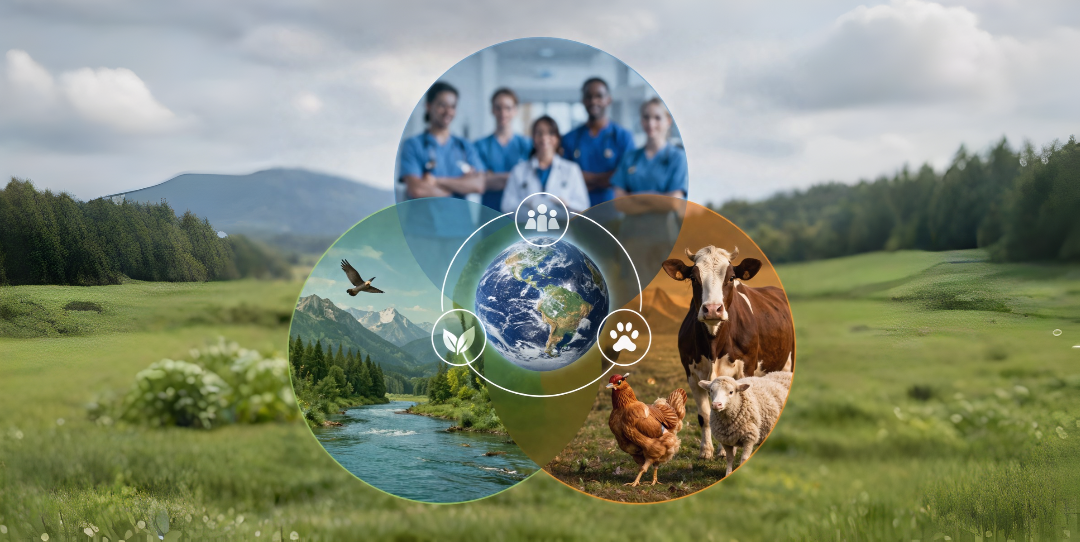

II. ANTITHESIS: ONE HEALTH EXCLUDES THE ENVIRONMENT FROM ITS SCOPE
Is the “One Health” concept, which links human, animal, and environmental health, an appropriate framework for achieving sustainable development? The answer is no. But this is not due to disagreement with the model itself.
The model is not incorrect; rather, it was designed for a different purpose. Applying it to sustainable development creates blind spots that the planet cannot afford. To fairly assess this issue, the relevant value is ecological integrity—that is, the ability of an ecosystem to remain healthy independently of human needs.
This is the appropriate benchmark because the question explicitly concerns environmental sustainability, not human well-being. Therefore, the criteria used to evaluate whether a model achieves this goal are those of biocentric governance—simply put, managing the natural world by respecting nature for what it is, not only for what it provides to humans. Since the environment is central, any model that treats nature as secondary to human health cannot claim to achieve environmental sustainability. This is the case with the “One Health” approach.
Certainly, everything is interconnected: human, animal, and environmental health are inseparable. This is undeniable. However, the “One Health” approach wrongly claims to break down the silos between health and environmental services.
During the COVID-19 pandemic, “One Health” principles were widely cited; yet environmental agencies were among the first to face budget cuts, as governments redirected resources toward human medicine and vaccines. Organizations such as WHO, CEPI, and national health ministries absorbed most of the funding. Environmental monitoring declined in over 40 countries, according to the 2021 UNEP report.
Human health takes priority over the environment
As clearly observed, animal and environmental health are not treated equally. In practice, during crises, all attention shifts to human health, while environmental sustainability is pushed to the background.
The “One Health” approach is anthropocentric—meaning decisions are made based on human needs, placing the environment second. For example, forests are valued primarily as potential reservoirs of pathogens that could affect humans. This reflects a biosafety logic.
Nature is studied and protected mainly to protect humans, not for its intrinsic value. This raises important concerns.
This can be seen in institutional language, such as the 2022 Joint “One Health” Action Plan by WHO, FAO, UNEP, and WOAH, where the environment is described as a provider of ecosystem services—essentially a resource for humans.
Another issue is the abiotic blind spot. Most threats to environmental sustainability are not biological but physical and chemical.
Environmental science primarily studies abiotic factors such as ocean pH, soil composition, carbon cycles, and water cycles—systems essential to life on Earth.
For example, soil degradation caused by industrial agriculture cannot be addressed like an infectious disease within the “One Health” framework—this is a major limitation.
Finally, in any framework linking environmental protection to human health, environmental funding becomes secondary and dependent on human health priorities.
Human health emergencies always take priority
As seen during the pandemic, global health security indices and OECD data show that governments consistently reallocate environmental budgets to medical responses in times of crisis. This raises doubts about the model’s ability to prioritize environmental sustainability in practice.
In short, while “One Health” is valuable for managing links between human and animal diseases, it was not designed to fully address sustainable development. It is a useful tool, but not the primary one.
It supports human and animal health, but largely ignores environmental degradation unless it directly impacts humans. For example, there are no major “One Health” projects addressing deforestation in Africa.
Thus, the concept has limitations. It is a strong theory, but its implementation is insufficient to make it a fully viable model.
One Health is not sufficient to save the environment
For instance, the approach focuses on zoonoses because they affect humans. This reflects a human-centered logic. Data shows that only 6.5% of “One Health” initiatives include environmental protection measures—a very low figure.
The environment is mentioned but rarely integrated in practice. This is a major limitation.
The approach reduces the environment to ecosystem services, ignoring broader ecological functions that are not directly useful to humans.
Meanwhile, environmental degradation continues: biodiversity loss, rainforest destruction, and planetary boundary disruptions such as ocean acidification and nitrogen overload.
Out of the nine planetary boundaries, “One Health” addresses only two, which is insufficient for full environmental sustainability.
The official “One Health” definition also acknowledges significant challenges in implementation, including political, legal, ethical, and financial barriers.
Therefore, to fully integrate environmental, human, and animal dimensions, “One Health” must be combined with other frameworks.
For example, agreements such as the Paris Agreement and the Montreal Framework already address environmental issues more directly. “One Health” should complement these efforts rather than replace them.
Ultimately, “One Health” is not a fully viable model for environmental sustainability. It is useful, but insufficient on its own.