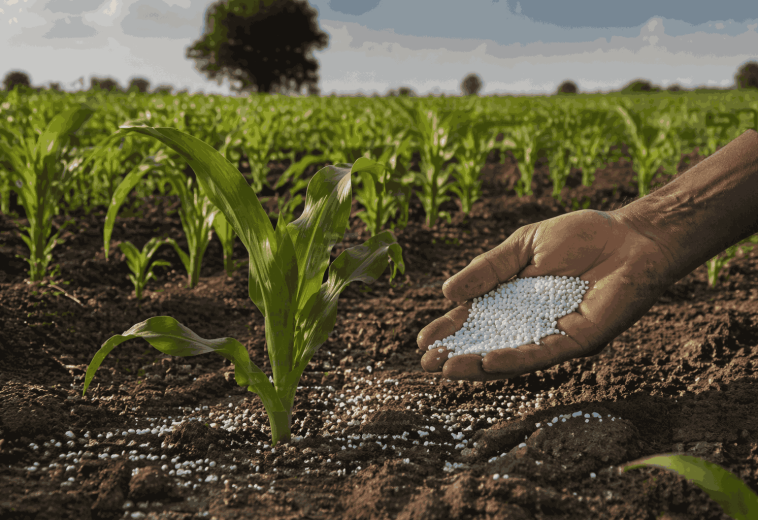

The Persian Gulf war is disrupting the entire value chain of global agricultural production. It has cut off access to fuel and fertilizer, endangering global food security and the standard of living of populations.
Forced to reduce fertilizer use, farmers — especially the poorest — would see damaging effects on yields and would create shortages that would worsen famine in poor countries, according to the United Nations.
The Gulf region has become a major fertilizer producer. One third of global fertilizer trade transited through the Strait of Hormuz. Gulf countries have exported $50 billion worth of nitrogen fertilizers since 2020. The fertilizer shortage has caused input prices to soar and triggered a frantic search for new supply sources.
Collateral damage
The Gulf is not the only region affected by the war. Fertilizer production is facing difficulties in all fertilizer-producing regions. Indeed, the war is causing a drop and a surge in gas prices, the main ingredient in nitrogen fertilizers. India and Bangladesh have reduced their production, and Europe is under pressure.
Nitrogen fertilizers contribute to half of global food production. Reducing fertilizer use will inevitably lead to lower yields and a surge in agricultural prices coupled with a production shock.
The damage does not stop at fertilizer production. Oil powers tractors, gas heats greenhouses. Various fuels move ships carrying agricultural products around the world. Oil is also used to make plastics for food packaging, not to mention cardboard manufacturing.
All farm machinery that sows, harvests, and sprays risks being immobilized due to rising oil prices. Many rice producers in Asia are reconsidering planting because of rising fertilizer and oil prices.
Food inflation
The disruption to maritime traffic is causing higher transport costs and longer delivery times for grains and oilseeds. Rising oil prices are increasing demand for diesel and biodiesel, thus significantly diverting agricultural products – soybeans, rapeseed, corn – used to make these biofuels, at the expense of human and animal food.
While food prices had begun to fall after the peak reached in 2022 at the time of Russia’s invasion of Ukraine, they have been rising again since March. The FAO is pessimistic about the months ahead. Indeed, shortages cause delayed price increases.
The purchasing power of Americans and Europeans, according to many economists, will fall by Christmas. In Great Britain, food inflation of 10% is expected in the coming months. In March, it already stood at 3.7%.
The Gulf war will obviously have a strong political and economic impact. Inflation could force central banks to lower interest rates, which are essential to restart growth. As for poor countries where food represents a large share of income, they are exposed to the risk of popular uprisings similar to the “Arab Springs”.
According to the FAO, countries in Africa, Asia and Latin America are among those most exposed to this crisis, while in rich countries, farmers can count on the support of their governments.
It is estimated that an additional 45 million people would join the ranks of already hungry populations. The WFP (World Food Programme) does not hesitate to mention the possibility of a food catastrophe.
Source: Wall Street Journal